Friday, March 31, 2017

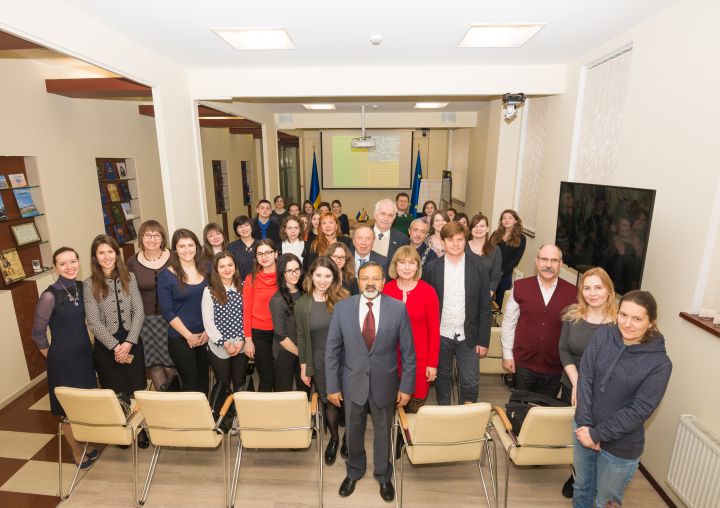
The meeting with Ambassador extraordinary and plenipotentiary Manoj Kumar Bharti (24 March 2017)


On the 16th and 17th of March, 2017 two research fellows from the Institute of Oriental Studies of the National Academy of Science of Ukraine – Maria Usoltseva and Yulia Fil had a defense of their PhD theses.


After successful defense young scholars were invited to the meeting with Ambassador extraordinary and plenipotentiary Manoj Kumar Bharti held in the GDIP (Directorate-General for Rendering Services to Diplomatic Missions) Media Center. His Excellency gave the lecture about the particularities of the formation and development of India. Maria Usoltseva and Yulia Fil also had an honor to deliver the short speeches about relevant topics on the meeting.

Tuesday, March 21, 2017

Fil Y. S. The formation of westernized Hindu political elites in North India (1858–1921)

Thesis to obtain the degree of Philosophy Doctor in History (Candidate of Historical Science) on the specialty 07.00.02. The World History. Diplomatic Academy of Ukraine under the Ministry of Foreign Affairs of Ukraine. Kyiv, 2017.

The thesis is dedicated to the formation of the Hindu political elites in North India during the period 18581921 from the time of Government of India Act 1858 until the Indian National Congress session in Ahmedabad when satyagraha tactic evolved from the private initiative of Gandhi to officially accepted national politics. We argue that from this time a new period of westernization which had many antiwestern displays began.

This research, which is based on numerous and diverse historical sources including official (acts, censuses, gazetteers, minutes) and personal (memoirs, letters, essays, news-paper articles, speeches), reveals the main characteristics of the formation of westernized political elites among Hindus in the region. To achieve this, the research is based on such historical methods as analysis and synthesis, elements of discourse-analysis, biography method and prosopography. The dissertation also uses such methodological instruments as «traditionalist modernist» gradation of the response of political elites on Western culture proposed by Indian historian B. Parekh, the instrument of dividing westernization into four phases (imitative, assimilative, asseverative, and creative), the civilization approach by Arnold J. Toynbee («challenge-and-response» frame) and by S. Hantington (three options for a developing nation: rejectionism, reformism, kemalism).

The analysis of the formation of westernized Hindu political elites includes institutional and personal levels. The first deals with modern political and socioreligious institutions in colonial north India, the second demonstrates the attitudes of leading politicians of Punjab and north-western provinces on various issues concerning India’s encounters with Western culture.

The research argues that the range of economic, political and demographic factors defined the characteristics of the formation of political elites among Hindus in North India. These include the dominant status of Hindu culture in the North Western provinces and its minor status in Punjab; the Hindu loss of political power in Punjab in the 13th century, the presence of a strong Mughal culture in North India and a policy of discrimination against Hindus by the Shia Mughal rulers in the Oudh state. Western education as the main precondition for forming the new political elite also had some peculiarities. The oriental line of education (Persian, Urdu, Sanskrit languages and literature) in Allahabad and Punjab Universities were much more popular than in presidential Universities. Students had much greater interest in western science than in literature.

Political development of Punjab and the northern western provinces gradually trended to representation on religious grounds and the first Hindu political organization Hindu Mahasabha emerged here.

The Western religious challenge received a particular response from politicians in North India: Christianity was rejected and the Bengali “creative” model of response in the form of Brahmo samaj was declared inappropriate in the region. Instead the organization of a defense type Arya samaj and Radhasoami faith was influential.

An analysis of the biographies of five of the most influential politicians of North India Motilal Nehru, Madan Mohan Malavia, Tej Bahadur Sapru, Bishan Narain Dar and Lala Lajpat Rai shows that all of them were deeply rooted in traditional culture through their traditional families, primary education and teachers.

The research states that during the entire period from 1858 until 1921, the assimilative phase of westernization dominated in the region. The government was treated as the main instrument of change in this phase. The imitative phase was absent in the region.

There are two nationalist ideologies among politicians in North India Hindu and Indian. Both represent political nationalism according to which the secular state was the main base for the Indian nation. Westernization in the religious sphere on a personal level showed that most of the five representatives of educated Indians were critical modernists in socio-religious issues specifically, that the caste system should not be rejected fully but should be reformed.


Monday, March 20, 2017

Usoltseva M. M. Social reform movement in Telugu and Tamil-speaking areas of Madras presidency in colonial India (1860–1930)

Thesis for the scholarly degree of Philosophy Doctor in History (the candidate of the historical sciences) according to the specialty 07.00.02 – the world history. – Diplomatic Academy of Ukraine under the Ministry of foreign affairs of Ukraine. – Kyiv, 2017.

The thesis is devoted to the study of the nature and peculiarities of the social reform movement in the Madras Presidency in 1860–1930 as the most large-scale manifestation of reform process in the South of colonial India.

The author managed to carry out a comprehensive study of the reform movement in the Madras presidency during the period of study, taking into account the socio-economic, geographical, cultural, political and ideological aspects of the South Indian reform process. The complex study is based on the position of the inclusion of the reform movement into the wider context of formation of the societies of modern type, which was a result of changes in social consciousness of Indians under the influence of Western intellectual paradigms and socio-economic changes that have occurred in the XIX century colonial India. The thesis highlights the main reform trends in the most numerous linguistic areas of Madras Presidency (Tamil and Telugu-speaking regions), the conditions of their origin, specificity and peculiarities of their reform strategies are clarified. Taking into consideration the heterogeneity of the movement and the ideological differences of the reform trends the general tendencies of the Madras movement are identified in the paper.

Attention is drawn to the general reform idea of the "South presidency" – a concept of the "new Indian woman", while claiming that a "women's issue" was the common subject of the social reform process in colonial India in general as well as its cornerstone.

In present study the formation of social reform movement is studied in its relationship with the regional revival (renaissance of the Dravidian culture) and the origin of nationalistic consciousness in a specific South Indian situation, taking into consideration the effect of the popular nationalist concepts in all-Indian scale (which arrived to Madras from Bengal and North-Western regions) as well as the alternative (local) notions of the nation.

Wednesday, May 4, 2016

Fil, Yu. Political Westernization of Educated Indians in Hindu Milieu of Northern India (1858–1921)


Political westernization is the process of accepting the parliamentary system in India, which started from the second half of 19th century. One of the key elements of political westernization is the idea of representative government, which became the most actual in the political context of Punjab and North-Western Provinces where Hindu-Muslim controversies were the most sharp. Representation of power had the explicit religious sense here. Gradual politisation of Hindu community and conjunction of reformists activity with traditional orientation can be the main feature of applying Western political models on the native soil in Northern India. Moreover, political activity of Hindu elites from Punjab and North-Western provinces proceeded along two lines. The first reform line was represented by Arya Samaj while the second quasi-reform was embodied by Hindu Mahasabha.

Thursday, September 3, 2015

Fil, Yu. Western Influence on Northern Indian Nationalists (the end of XIX – the beginning of XX century)


Actual problem of early Indian nationalism unfolds through the analysis of western influence on Northern Indian nationalists. Numerous works of early national movement participants demonstrate consistent patterns in accepting Western ideas. Majority of nationalism thinkers (“conservative line” of national movement) were involved with the ideas of European orientalists, German romanticism thinkers, modern periodization of history and modern believes about religion. Minority of them (“liberal line” of national movement) accepted only English liberal philosophy. Thus cultural nationalism became more actual for the thinkers of that region.

Friday, February 20, 2015

Devotees Brave War-Torn Ukraine to Provide “Food For Life” (Madhava Smullen for ISKCON News on Feb. 20, 2015)

 for ISKCON News on Feb. 20, 2015
z_None
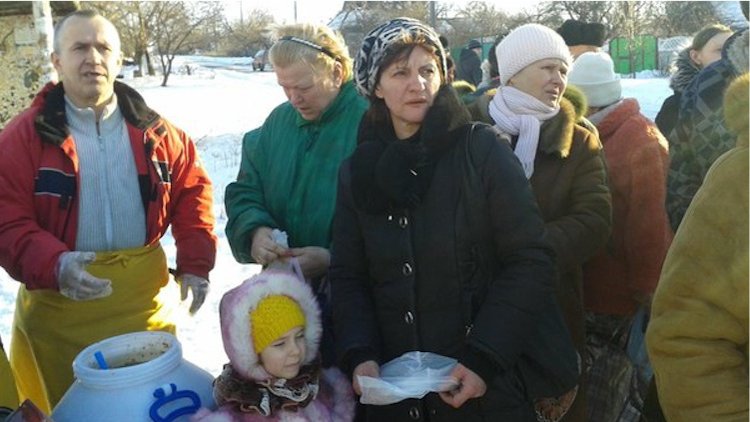
A brave group of devotees have mounted a Food For Life effort and are preparing enough sanctified vegetarian food, or prasadam, to distribute to 600 to 800 people every day in the war-ravaged city of Donetsk, South-East Ukraine.
When Kishora Gopala Das, Yuthesvari Dasi and others at the ISKCON temple in Donetsk – which, fortunately, is not in a dangerous part of the city – saw the situation escalate last year, they wanted to help citizens in affected areas.
The city and especially its suburbs were under attack, buildings ruined, and communications damaged. There was no water and electricity, and food was at a shortage.
“Horrible things were around us,” Yuthesvari says. “Citizens began to kill each other. We understood we had to act. But it was dangerous to distribute books or go on Harinama. So we decided to distribute prasad.”
In July 2014, devotees began making breads and pies and bringing them to men, women and children who had left their houses due to bombardment and were living as refugees in hostels.
In October, the situation began to get even more serious. People in Donetsk had no money and were beginning to starve.
With ISKCON Ukriane Regional Secretary Acyuta Priya Das’ support, the Donetsk devotees launched an organized Food For Life effort consisting of thirty volunteers.
“Soon after that on November 19th,  we went to the nearby town of Communar, where the people were in a dire condition,” says Yuthesvari. “They cried and were very happy to meet the devotees.”
Now, the Food For Life team, led by cook Rohinandana Das,  prepares 500 to 650 liters of savory buckwheat porridge with vegetables and 1,000 to 1,500 loaves of bread every day, five days a week. They then distribute them in the towns of Communar, Hartsizsk and Illovaysk as well as the Pastuhovka and Kalininsky region of Donetsk.
Their day starts early, with baker Dhiranaika Das starting on the bread at six o’clock in the morning, and Rohininandana and around a dozen other devotees starting to peel veggies at 8:30am. By 2:00pm the prasadam is ready and packed into containers. Devotees are out distributing it for five hours, and by 7:00pm they’re back at the temple.
“We deliver prasadam to the elderly, the poor, sick and immobile people, and victims of bombings,” says Yuthesvari. “People are grateful. They say thank you to us and to God, wishing us all the best. Some of them say it gives them moral support. They ask us to come again and bring some more food. They say its tasty. Buckwheat is not the cheapest thing here -- it’s a delicacy now.”
People in some towns greet the devotees with “Hare Krishna.” In others, Hare Krishna melodies are played during prasadam distribution, and devotees distribute the magazine “New Era” about vegetarianism and the Krishna conscious lifestyle.
“We are also often invited to local TV stations, and once did a two-hour long question and answer program on Krishna consciousness,” says Yuthesvari.
She adds that God is much more at the forefront of peoples’ minds now in Donetsk – it’s hard to find an atheistic person there.
“People are suffering and want to know when it will be finished,” she says. “They don’t know when the next bomb will fall.”
Next, Donetsk devotees want to set up food distribution centers in different towns in the region, provided they manage to get the help of experienced people to develop the programs.
“There is a lot to do here and the demand for Food for Life is growing along with its popularity,” says Yuthesvari. “People get to know about us, and they call us asking for us to come to their area.”
When asked how long the Donetsk Food For Life program will continue, she answers, “Well, we hope we can continue to serve God and the people for as long as it is needed. We are just happy to be useful to people at this time.” 
Source: The News Agency of the International Society for Krishna Consciousness

URL: https://iskconnews.org/devotees-brave-war-torn-ukraine-to-provide-food-for-life,4821/

Friday, December 19, 2014

Ukrainian Devotees Distribute Krishna's Message in War Torn Region (Madhava Smullen for ISKCON News on Dec. 19, 2014)

By:  for ISKCON News on Dec. 19, 2014
z_None
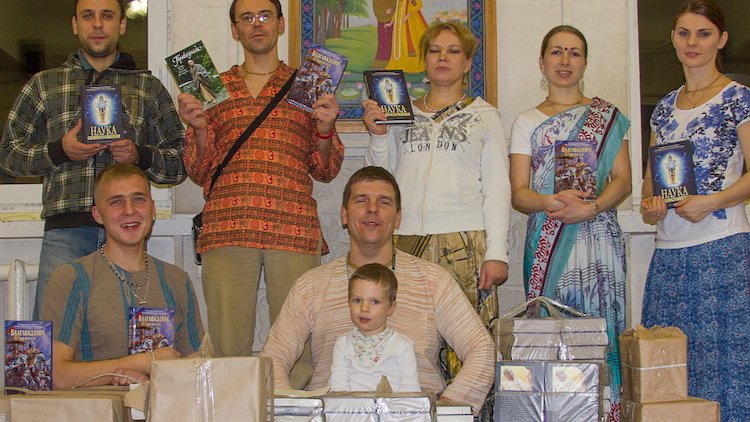
Mahendra Das (in front center with child) leads Namahatta group of enthusiastic book distributors

In a country torn apart by war and suffering a plunging economy, Ukranian devotees are braving sub zero winter temperatures to distribute Srila Prabhupada’s books this December. And they’re being rewarded by a receptive public.
“People are very grateful,” says ISKCON Ukraine Regional Secretary Acyuta Priya Das. “They’re tired of hearing scary news about the war. The whole society is starving for something positive. So when they see harinama or are inpired by book distributors, they feel very indebted. We just got a long letter of appreciation from one member of the public who was so moved to see our winter Harinama on the street.”  
With the war rendering people “politically and economically depressed and hopeless,” according to Acyuta Priya, they have become more receptive to spiritual values. When this year’s “Prabhupada Marathon” officially began on November 30th at the Sunday Feast program at ISKCON Kiev, devotees distributed 8,314 big and “maha-big” books in just one hour.
By the time the marathon ends on December 31st, they hope to have distributed 55,000, despite the challenges presented by the economy.
Helping that goal along is the huge number of devotees involved in book distribution in Ukraine – around 700. Many are householders who go out on the street in their spare time, buy books to give as presents to relatives or friends, or donate sets to libraries, hospitals and schools. Others are congregation groups called Namahattas – there are 50 in Kiev alone -- who go out to distribute together.
The rest is distributed by the country’s five brahmachari ashrams. Led in Kiev by Antaryami Das and in Dnepropetrovsk by Yasoda Kumara, these dedicated celibate monks brave the cold to distribute books five days a week, staying out from morning till evening.
“During the winter Prabhupada marathon it is freezing outside, with snow and wind,” Acyuta Priya says. “It’s no joke to stay outside the whole day!”
As well as distributing in their local cities, devotees also embark on an intensive two-week tour across the country once a year, with seventy to eighty brahmacharis renting a bus and covering two to three towns a day.
Serendipitous encounters are commonplace during these. “Just today, I heard that one Bhakta Dima was distributing books when he spotted a young man with big headphones on,” says Acyuta Priya. “He tried to stop him, but the boy couldn’t hear because of his headphones. Finally, he got his attention with guestures.”
As he spoke to the young man, a spontaneous thought came into Bhakta Dima’s mind. “You know, you can overcome death!” he said.
The boy was so shocked that he jumped in surprise. “How do you know my thoughts?” he said. “You must have some supernatural abilities. I was just walking and thinking about how to overcome death! Without solving this problem life is meaningless.” He then gratefully took Srila Prabhupada Lilamrta and gave a donation.
As a result of these kinds of encounters, Kiev temple receives thirty-five to fifty newcomers every Sunday. With the attention given to guest and devotee care programs, many join and stay.

Of course, devotees avoid distributing books in Eastern regions of Ukraine where there is active fighting, such as Donetsk and Lugansk. “It is very risky to do book distribution in the war area because official religious laws there are very tough -- the only permitted religion is Orthodox Christianity,” Acyuta Priya says. “Some protestant pastors in those areas were executed by shooting. As we did not want to put devotees’ lives at risk, we asked book distributors to leave and move to safer places for more effective preaching.”
Devotees do, however, continue to maintain Food For Life programs in war-affected areas. Some people in these places do not even have any food, what to speak of money,” says Acyuta Priya. “Many hadn’t had hot food for months. Some of them, with tears in their eyes, thanked devotees for saving their lives. They see devotees as their saviours.”
Meanwhile devotees continue to look for ways to increase book distribution in the rest of the country. The brahmachari teams are saving up for a 31-person TATA van so that they can tour the country throughout the year. Currently they are only able to do a two-week tour once a year because they do not have a suitable vehicle.
So far, they have collected $7,000 themselves over three years, but they urgently need $22,000 more to be able to purchase their van.
“When they travel all together rather than in small groups, they are much more inspired and distribute thrice the amount of books in less time,” says Acyuta Priya. “And their Harinamas create a real event on the streets, getting people interested in buying books. So we would be grateful for some help in this way for our Ukraine book distribution mission.”
Source: The News Agency of the International Society for Krishna Consciousness

URL: https://iskconnews.org/ukrainian-devotees-distribute-krishnas-message-in-war-torn-region,4733/